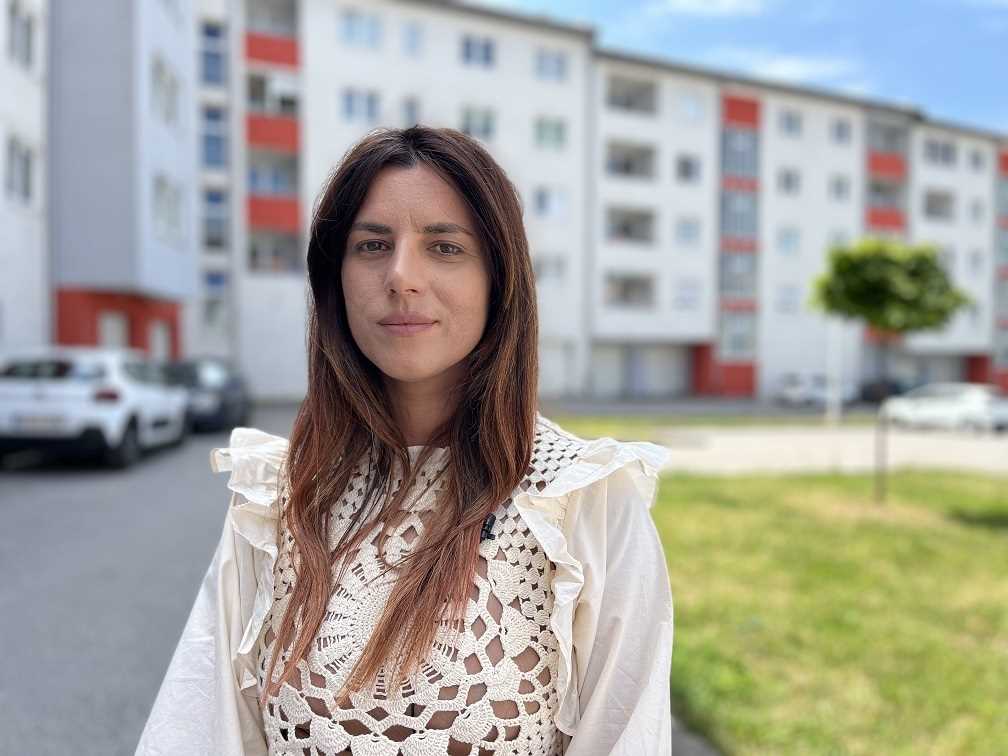
Journalist Sanja Vasković shows by her own example that true, investigative, questioning and critical journalism is not dead. There are no more journalists like her in Bosnia and Herzegovina, and there are even fewer in local communities. In the area of the City of East Sarajevo, there is only one investigative media - Spin info. The editor and founder of this portal, and our interlocutor, Sanja Vasković, suffers a lot of pressure because of her work, and politicians do not hesitate to put that pressure on her family members too. Hiding information, misogynistic comments, lawsuits... these are just some of the ways in which the government, as well as the opposition, make the work of our interlocutor difficult. Vasković tells Politicki.ba what it is like to be an investigative journalist in East Sarajevo.
"Perhaps it would be good to mention that a
public institution sued me for defamation because I announced that they were
operating with a negative revenue, which is a report that they themselves
submitted to the assembly, which then accepted the same report" says Sanja at the beginning of conversation.
Politicki.ba: What obstacles do you
encounter in your work from the authorities?
- When we talk about obstructions set by the authorities, they primarily concern the denial of the right to information, which is one of the fundamental rights of democracy and the improvement of society. The problem is the (ir)responsibility of those who perform public functions, who in most cases dispose of citizens' money as if it were their own and believe that they do not need to answer to anyone. An good example of this is the case when I waited a year for information that should be available to every citizen, not just a journalist, despite all institutional means, including the recommendations of the human rights ombudsman, I was still denied information of public importance. In addition to the "silence of the administration", obstructions in our work also refers to the attitude towards journalists who critically examine someone's work and their decisions, which is essentially the job of a journalist. Subtle pressures and verbal attacks are common, as well as pressures put on my family. It is also neccessary to mention the example when I was answered by them leaving the podium, which shows the attitude towards journalists, which unfortunately is supported by the current rhetoric of the government by a large number of citizens. If you have a situation where, according to a survey of BiH journalists, as many as 74% of respondents in Republika Srpska consider it justified to sometimes attack or hit a journalist, then something is rotten in our society.
Politicki.ba: Is the government the only
one that is obstructing your work?
- Unfortunately no, there is also the opposition. So, the people who
should be the responsible political opposition - are not responsible in the
least, although there are rare exceptions, a couple of them who, without the
leader's permission, still can't do much. Those who are supposed to point out
the government's failings and make well-argued criticisms actually deal with
minor matters, such as installing lighting and the like, without getting into
the essence of the problem, namely corruption and crime. What happens is that
at assemblies they publicly thank the authorities (mayor) for giving money for
something they proposed, as if it is not money that came from all of us and as
if it is not his job to do just that. And the obstruction of my work by the
opposition also refers to, believe it or not, not answering questions. They
will almost never comment when I call for a statement, which is extremely
irresponsible towards those who elected them. So, in East Sarajevo, we are
talking about a connected system of government and opposition, where the only
problem is these few free-thinking people.
Politicki.ba How difficult is it to work under the circumstances in which you are the only journalist in your town who does investigative journalism?
- Maybe it's difficult, but I don't see it that way, I think it's
harder to close your eyes and write in the service of the system, to be a lever
for the destruction of society and to live up to this twisted system of values
that we live in, as a good part of the media, that is - journalists, do. The
only difficulties relate to the already mentioned problems with access to
information, not answering questions and possible defamation lawsuits, which
are classic SLAPP lawsuits aimed at scaring me, creating some kind of
self-censorship, and the like, but in my case they only became a confirmation
that I am obviously doing well my job. Perhaps it would be good to mention that
a public institution sued me for defamation because I announced that they were
operating with a negative revenue, which is a report that they themselves
submitted to the assembly, which accepted the same report, but someone thought that
by presenting the facts, I am "damaging the reputation of the municipality",
which is really absurd. Fortunately, the lawsuit was dropped.