From the beginning of this year until today, the Helpline
for journalists has received as many as 62 reports of attacks on journalists.
During the whole of last year, 79 reports were registered on the Society of BH
Journalists platform.
"This means that we have an increased number of attacks
on journalists. The number of direct threats is increasing, such as threats of
liquidation or physical attacks, and damage to journalist property is also
increasing... These are all criminal acts. And they have increased by as much
as 137 percent.
And we also have a 40 percent increase in political pressure
from officials that is exacted on journalists and media houses. The situation
is not good at all and is progressively getting worse," Borka Rudić tells
Politicki.ba.
The head of the Association of BH Journalists states that
the attack on journalists and the threats directed at them coincide with the
radicalization of the political scene.
This is a trend, she says, that has been recorded for the
past 10 years, and has accelerated in the last three years.
She also points out that, parallel to the increase in the
number of attacks on the media and journalists, there have also been attempts
to "discipline" journalists by the authorities.
Rudić specifies that this can be seen through the
criminalization of defamation in the Republika Srpska, the new law on
non-governmental organizations that was passed in the preliminary reading in
the entity parliament, but also the activities related to the passed Law on
Freedom of Access to Information at the level of Bosnia and Herzegovina, and
the activities of the government of Canton Sarajevo to try and pass a new law
on public order and peace that also deals with the issue of fake news.
She adds that the EU Delegation and the Office of the
Ombudsman gave a negative opinion on the Law on Freedom of Access to Information.
"Unlike in all other cases, the government of Canton Sarajevo has included the journalistic community in the issue of the law on public order and peace. We have had four meetings so far, and soon - after the summer break - new meetings and discussions will follow. We hope that we will reach a solution which will not encroach on the rights of the journalistic community," Rudić tells Politicki.ba.
She points out that she hoped that BiH, after receiving
candidate status in December last year, would improve the current situation of
journalists.
"The opposite happened. The situation with media
freedom in BiH drastically worsened, which is paradoxical. We expected the
opposite.
We thought that the candidate status and the 14 conditions
placed before BiH, which include freedom of expression and media freedom, would
lead politicians to finally start fulfilling the EU conditions if we want to be
part of that community as soon as possible through the beginning of
negotiations," Rudić continued.
She draws attention to the problem of a very high degree of
impunity for attacks on journalists.
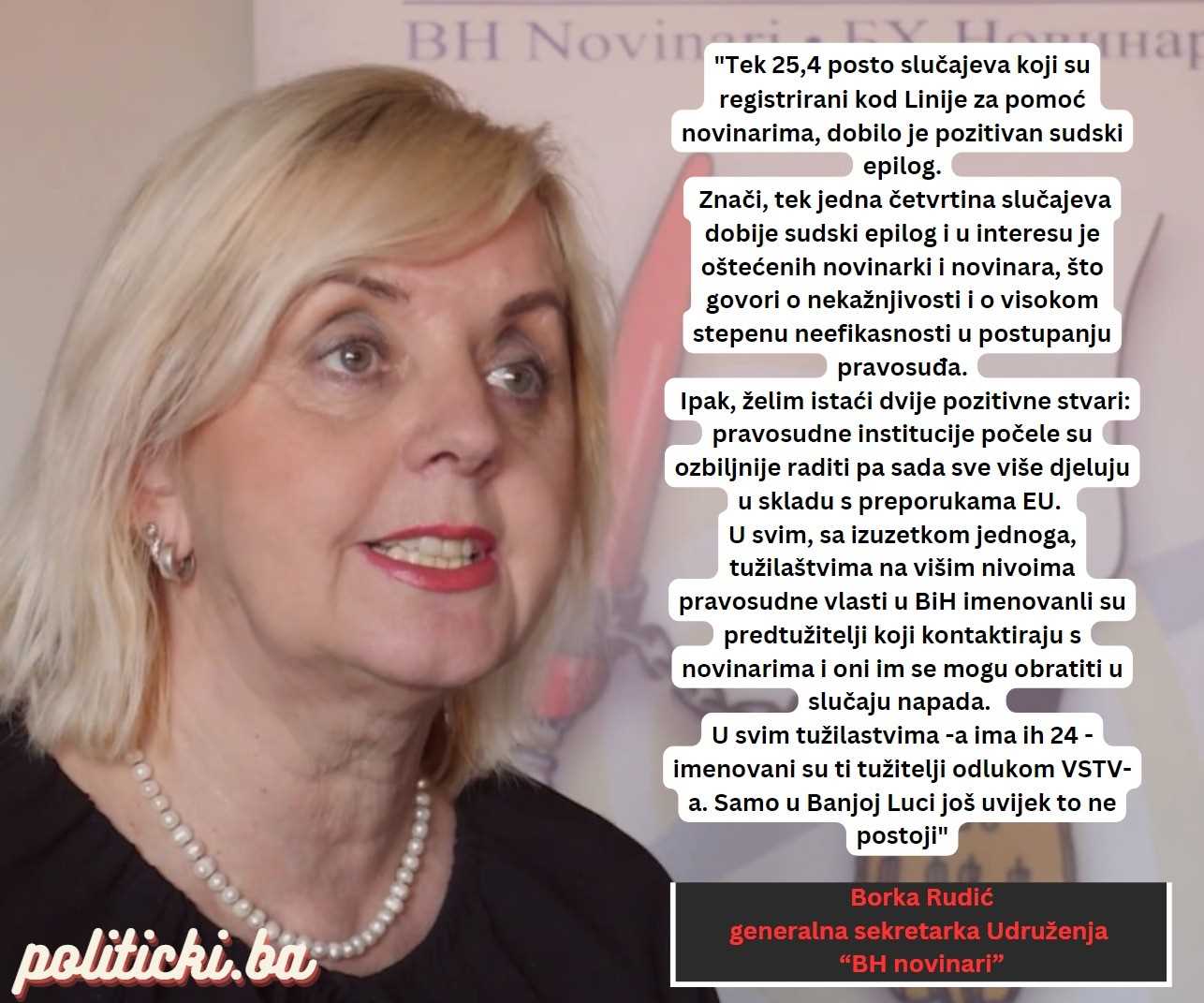
"Only 25.4 percent of the cases that were registered
with the Helpline for journalists received a positive court outcome.
This means that only one-fourth of the cases receive a
judicial epilogue and it is in the interest of the injured journalists, which tells
a lot about the impunity and a high degree of inefficiency in the judiciary
system.
However, I would like to point out two positive things:
judicial institutions have started to work more seriously, and now they are
increasingly acting in accordance with EU recommendations. In all prosecutor's
offices, except one, that are at the higher levels of judicial power in Bosnia
and Herzegovina, pre-prosecutors have been appointed who contact journalists
and they can turn to them in the event of an attack.
In all prosecutor's offices - and there are 24 of them -
these prosecutors were appointed by the decision of the High Judicial and
Prosecutorial Council. It still doesn't exist only in Banja Luka," the
leader of the Association of BH Journalists further told Politicki.ba.
She also reports that the HJPC brought two more important
things - records of attacks on journalists will be kept and they will be
prioritized, according to official duty, and cases of attacks on journalists
will be dealt with more quickly and efficiently. We can count on, therefore,
that they will fight against attacks on journalists faster and more efficiently
than before.